Creative Paving Ideas That Local Paving Contractors Are Installing Right Now
Your outdoor surfaces say a great deal about your home before anyone even reaches the front door. A beautifully designed driveway, a thoughtfully laid garden path, or a patio that flows seamlessly from your living space into the garden — these aren’t just functional features. They’re design statements that shape the entire character of your property.
The good news is that paving design has come a long way. Local paving contractors across the country are installing surfaces today that bear little resemblance to the plain concrete slabs and standard red brick driveways of twenty years ago. From large-format porcelain to hand-cut natural stone, the options available to homeowners have never been more exciting — or more varied.
Here are the most inspiring paving ideas gaining traction right now, and what to look for when choosing a local contractor to bring them to life.
1. Large-Format Porcelain Slabs: The Contemporary Statement
If there’s one trend that has defined premium paving over the last few years, it’s the rise of large-format porcelain. Slabs measuring 900mm x 600mm, or even 1200mm x 600mm, create a sweeping, seamless appearance that looks like something straight out of an architectural magazine.
Available in finishes that convincingly replicate concrete, marble, wood grain, and natural stone, porcelain suits everything from ultra-modern rear patios to contemporary driveway aprons and pool surrounds. It’s virtually maintenance-free, frost-resistant, and holds its colour and texture far longer than natural alternatives.
Local paving contractors who work with large-format porcelain need specific skills and equipment — incorrect cutting or bedding on an inadequate sub-base leads to cracking and lippage. Always ask to see completed porcelain projects before committing.
2. Mixed Stone and Planted Pathways
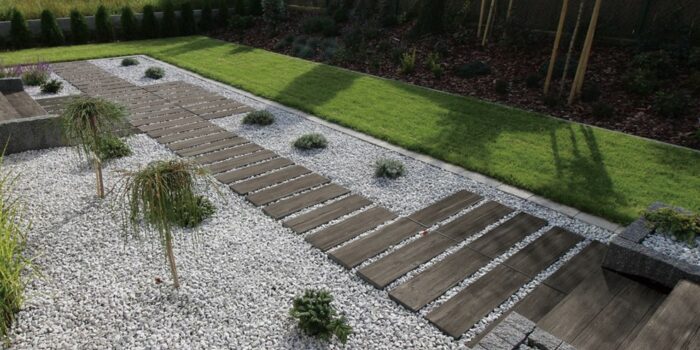
One of the most visually arresting garden path ideas gaining momentum with forward-thinking local paving contractors is the mixed stone and planted pathway. Rather than a continuous hard surface, stepping stones — in slate, limestone, or irregularly shaped sandstone — are set into low ground-cover planting such as thyme, mind-your-own-business, or ornamental grasses.
The effect is organic, relaxed, and beautifully tactile. It works especially well in cottage gardens, Japanese-inspired spaces, and naturalistic planting schemes. It also reduces the overall hard surface area, which improves drainage and creates micro-habitats for insects and wildlife — an increasingly valued quality in residential garden design.
The key to pulling this off is consistent rhythm and spacing between stones, and selecting a ground-cover plant that can handle light foot traffic without dying back entirely in winter.
3. Patterned Block Paving with Contrasting Borders
Block paving doesn’t have to be monotone or predictable. One of the most popular upgrades local paving contractors are specifying is the use of two or three complementary block colours to create bold geometric patterns — often combined with a contrasting single-colour border that frames the whole driveway or courtyard space.
A charcoal and silver herringbone centre with a buff or terracotta single-course border, for example, creates a sense of formality and finish that elevates even a modest suburban driveway. For larger spaces, basket-weave or circular fan patterns within a defined rectangular border deliver real architectural drama.
The trick is restraint — keeping the palette to two or three tones and ensuring the pattern relates to the scale of the space rather than overwhelming it.
4. Cobblestone and Sett Feature Details
Granite setts and cobblestones are staging a confident comeback, not necessarily as the primary paving surface, but as feature elements within a broader design. Local paving contractors are increasingly specifying granite sett borders to frame tarmac or resin-bound driveways, cobblestone drainage channels across paved surfaces, and sett aprons at the base of steps or at driveway entrances.
These details add texture, craftsmanship, and a sense of permanence that smooth, uniform surfaces simply can’t replicate. They also age beautifully — granite setts look better with every passing decade, developing a patina that only enhances their character.
5. Resin-Bound Driveways in Unique Aggregate Blends
Resin-bound paving has moved well beyond its early reputation as a functional but somewhat plain surface. Today, local paving contractors are working with aggregate blends that incorporate rose quartz, silver flint, golden gravel, and even recycled glass to create surfaces that are genuinely beautiful as well as highly practical.
The permeable nature of resin-bound paving makes it an excellent choice for front driveways where surface water management is a concern — and its smooth, weed-resistant finish keeps maintenance requirements extremely low year-round. Custom aggregate blends can be tailored to complement the colour of brickwork, render, or roof tiles, creating a genuinely considered exterior design.
6. Integrated Steps with Oversized Treads
Steps are too often treated as an afterthought in paving design — a purely functional necessity. Yet they offer some of the most striking design opportunities in any exterior scheme. Local paving contractors are increasingly designing steps with generously oversized treads, low risers, and flush or near-flush surfaces that blur the line between step and platform.
Cantilevered bluestone or porcelain treads set into a rendered or natural stone riser wall, for example, create a floating, contemporary effect that looks exceptional in modern garden settings. Wider, shallower steps also feel more welcoming and generous — an effect that pays dividends both aesthetically and practically.
7. Courtyard-Style Paved Entertaining Zones
The concept of the outdoor room has fully arrived. Local paving contractors are designing and installing paved courtyard spaces that function as genuine extensions of the home’s interior — complete with defined zones for dining, lounging, cooking, and even outdoor fire features.
Material zoning plays a key role here. A dining area might be defined by large-format porcelain, transitioning to a textured natural stone zone around a fire pit, with a gravelled border softening the edges. Changes in paving material serve the same spatial function as rugs and furniture placement indoors — creating distinct areas without physical barriers.
Low-level lighting integrated into paving, steps, or surrounding walls completes the transformation, making the space as usable after dark as it is during the day.
8. Permeable Paving for Sustainable Front Gardens
As planning requirements around permeable surfaces tighten and environmental awareness grows, more homeowners are choosing sustainable paving options that allow rainwater to drain naturally through the surface rather than running off into drains.
Permeable block paving, resin-bound aggregate, and gravel with cellular ground reinforcement grids all offer attractive, durable alternatives to impermeable concrete or standard tarmac. Many local paving contractors now lead with permeable options as their default recommendation for front driveways — a reflection of both planning requirements and growing client demand for environmentally responsible choices.
The aesthetic range of permeable paving has expanded dramatically. Modern permeable block systems come in the same finishes and colours as conventional blocks, meaning there’s no visual compromise involved in making an environmentally sound choice.
9. Warm-Toned Natural Stone for Traditional Homes
For period properties — Victorian terraces, Edwardian semis, farmhouses, or traditional cottages — nothing quite matches the warmth and authenticity of natural stone paving. Buff sandstone, honey-coloured limestone, and aged York stone all carry a visual weight and character that manufactured materials simply can’t replicate.
Local paving contractors working in historic or rural settings often source stone that’s sympathetic to the local vernacular — using stone types that reflect the regional building tradition. Beyond aesthetics, natural stone develops a beautiful patina over time, improving with age in a way that enhances rather than diminishes the character of the property.
10. Monochrome Minimalist Schemes for Modern Architecture
At the opposite end of the design spectrum, some of the most striking recent paving work involves paring the palette back to a single tone — charcoal, slate grey, or cool white — and letting texture and proportion do all the work.
For contemporary homes with large glazed elevations, flat roofs, or geometric forms, a monochrome paved exterior feels architecturally coherent. Smooth, large-format grey porcelain or brushed concrete pavers, laid in simple running bond with near-invisible grey jointing, creates an exterior that feels curated and resolved.
This kind of scheme demands precision — uneven levels, visible jointing, or inconsistent colour are far more obvious against a minimal backdrop than they would be in a busier design. Which is, once again, why the quality of the local paving contractor you choose matters as much as the materials themselves.
How to Find Local Paving Contractors Who Can Deliver These Ideas
The gap between an inspiring paving concept and a beautifully executed reality comes down to craftsmanship, preparation, and professional standards. When searching for local paving contractors to bring a project like this to life, keep the following in mind:
Ask to see directly comparable work. If you want a large-format porcelain patio, ask to see porcelain projects they’ve completed — not just block paving or tarmac driveways. Different materials require different skills and equipment.
Discuss the sub-base in detail. The base is where the longevity of any paving project is determined. A contractor who can explain clearly what sub-base specification they’re using, and why, is demonstrating the kind of technical knowledge that separates professionals from those simply laying slabs.
Get a full written specification. Materials, depths, drainage, edging, jointing, and timeline should all be committed to in writing before work begins.
Check reviews for projects similar to yours. Generic positive reviews are less valuable than reviews from clients who had a comparable project carried out. Look for specifics.
Value experience over price. The cheapest quote almost always involves a compromise somewhere. With paving, that compromise is usually invisible until the surface starts to fail — often within two or three years of a poor installation.
Final Thoughts
Paving is one of the most enduring investments you can make in your home’s exterior. The ideas featured here — from organic mixed-material pathways to bold monochrome courtyard schemes — represent what’s possible when great design meets skilled, professional installation.
Finding local paving contractors with the experience, portfolio, and professional standards to execute work at this level takes a little research. But it’s research that pays off every time you look out at your garden, pull onto your driveway, or step outside to entertain on a summer evening.